Airspace Awareness for Airports and Critical Infrastructure
Gridence provides real-time awareness of low-altitude airspace by combining traffic monitoring, drone detection, ADS-B UAT traffic broadcasting and GNSS interference awareness. Validated at Griffin Tech Days 2026 · Rovajärvi, Finland
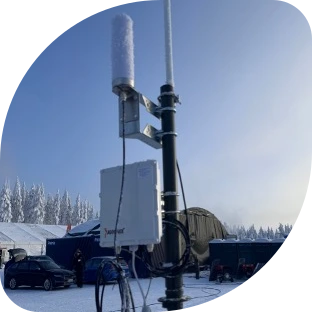
Understanding the airspace around your operations.
Drone traffic is increasing and GNSS interference has become more common across Europe. Gridence helps operators understand what is happening in the local airspace and respond quickly to anomalies. The system combines multiple sensors into one clear operational picture.
What Gridence provides
Real-time airspace picture
Monitor aircraft and drone traffic in the vicinity of your operations in real time. Gridence combines multi-sensor data and AI-driven traffic analysis to build a continuously updated picture of the local airspace, helping operators detect unusual activity early and maintain situational awareness around airports, drone operations, and critical infrastructure.

Drone detection
Identify drones operating near your area and determine their location in real time. Gridence detects commercial drones through their broadcast signals and can also integrate additional sensors to identify drones that do not transmit identification data. When possible, the system can also help locate the drone operator, enabling faster response to unauthorized activity near airports, drone test areas, and other sensitive sites. AI-driven analysis identifies unusual behaviour patterns and can suggest appropriate response actions, helping operators act faster when it matters most.

Traffic broadcast to aircraft
An ADS-B UAT ground station broadcasts real-time traffic information directly to nearby aircraft. Pilots receive situational awareness data in their cockpit displays or tablet navigation applications, helping them see other traffic operating in the area. This improves safety and situational awareness especially at regional airports and airfields where traditional surveillance coverage may be limited.


GNSS interference awareness
Detect jamming and spoofing events and understand when satellite navigation cannot be trusted. Gridence monitors the radio environment and alerts operators when GNSS interference is detected in the surrounding area. Early detection helps operators assess the reliability of satellite navigation and maintain safe operations during periods of degraded positioning signals.
Operational benefits
Gridence improves situational awareness in low-altitude airspace and helps safety and operations personnel, pilots and drone operators detect, understand and respond to abnormal situations in real time.
Clear visibility into low-altitude airspace
Faster and more informed operational decisions
Early detection of GNSS interference and anomalies
Designed for airports, drone test centers, and critical infrastructure
Common questions about Gridence solution
What does Gridence actually do?
Gridence provides a real-time situational picture of the airspace around your operations. The system combines data from multiple sensors and uses AI-based traffic analysis to present aircraft, drones, and potential anomalies in a single operational view. When objects are within range, observations can be validated using a high-capability camera.
To maintain a reliable situational picture and support operational safety, the system also detects GNSS interference and helps locate its potential source.
How is your data secured?
All system data is processed and stored on servers located in Finland. The data remains within the European Union and is not transferred outside Europe. Secure communication protocols and industry-standard encryption are used to protect data during transmission and storage.
This approach ensures a high level of data protection and compliance with European data protection regulations.
Is the system compliant with aviation regulation?
Gridence identifies cooperative air traffic using established aviation standards such as ADS-B, FLARM, OGN, and ADS-L. The system can also utilize ADS-B UAT, an internationally standardized technology that remains underutilized in Europe.
Receiving standard air traffic broadcasts is license-free. However, operating an ADS-B UAT ground station requires a radio license, as the station transmits to aircraft. We handle the licensing process on behalf of the customer as part of the system delivery.
Does the system generate alerts?
Yes. The system allows operators to define monitored areas and operational boundaries. Alerts can be generated if an unauthorized aircraft or drone enters the monitored airspace. Similarly, the system can trigger alerts if an aircraft leaves its assigned or expected operating area.
The system uses AI-based traffic analysis to distinguish between normal air traffic patterns and unusual or potentially risky behaviour.
Sensors detecting cooperative traffic provide valuable baseline data about normal traffic patterns and help differentiate between cooperative and non-cooperative aircraft, improving the system’s ability to identify anomalies and generate meaningful alerts.
What types of aircraft can the system detect?
Gridence can integrate multiple sensor types to monitor:
cooperative aircraft using ADS-B, FLARM, OGN, or ADS-L transponders
drones transmitting Remote ID
non-cooperative traffic, depending on locally installed sensor configuration
At close range, the detection is automatically validated using a high-performance zoom camera.
Is the system modular?
Yes. Gridence is designed with a modular architecture. The system can integrate different sensor types depending on the operational needs, such as traffic receivers, drone detection sensors, cameras, GNSS interference monitoring, and other situational awareness sources. This allows the system to start with a basic configuration and expand over time as requirements evolve.
Situational awareness for modern airspace
Drone activity is increasing and GNSS interference is becoming more common. Gridence helps organisations detect anomalies, monitor traffic and understand what is happening in their airspace.
Discuss your airspace monitoring needs
Free initial consultation
Modular system that grows with your needs
Transparent pricing
Talk to an expert